The USAID Honduras Irrigation Development Project was a seven-year program to promote irrigation technology and coverage to support winter fruit and vegetable production and export to the United States. I arrived in Honduras in October 1987 and was assigned to be the project manager in May or June 1988. I worked on the project for a year and a half and managed its redesign from focusing on smallholder farmers to a commercial project working with mid to large farmers.
The impact was noted in the final evaluation, with the project cited for reducing national unemployment by 1.5%, expanding production and export of winter fruit and vegetables to the US, equivalent to 5% of total agriculture exports, and creating the conditions necessary for a vibrant national irrigation capacity in Honduras.
The interim evaluation was done in 1989, and the early implementation problems were unfairly blamed on the lack of USAID oversight during 1986 - 1987. When I became the project manager for USAID in mid-1988, the main issue I found was an unworkable credit program (it would have commercial banks lending to unbankable clientele (small-scale farmers) and a shared management structure within the Directorate of Water Resources at the Ministry of Agriculture that was confusing and sent mixed signals to the project staff.
David Flood, the deputy director of the agriculture office in USAID Honduras, recommended that we bring in Rafael Diaz, a private consultant, to bring the entire team together – something like 150 people – and develop a project work plan for 1989. We went to Zamorano Agricultural College outside Tegucigalpa for a three-day retreat. Rafael led a very interesting log frame methodology with each team determining their goals, activities required to reach them, and the inputs/resources needed to finance the activities. We came out of the exercise with a detailed work plan that showed actions, timelines, outputs, and progress toward project goals. It was the first time I saw the power of this methodology to create a strategy that was owned by the staff – they owned it because they designed it. I remember that later, when a staff member complained to me about what he considered an overly ambitious goal in his component, I said, “Ok, but you designed it and signed off on the final plan.” He took it to heart and doubled down to get the job done. I was amazed at the power of the log frame process.
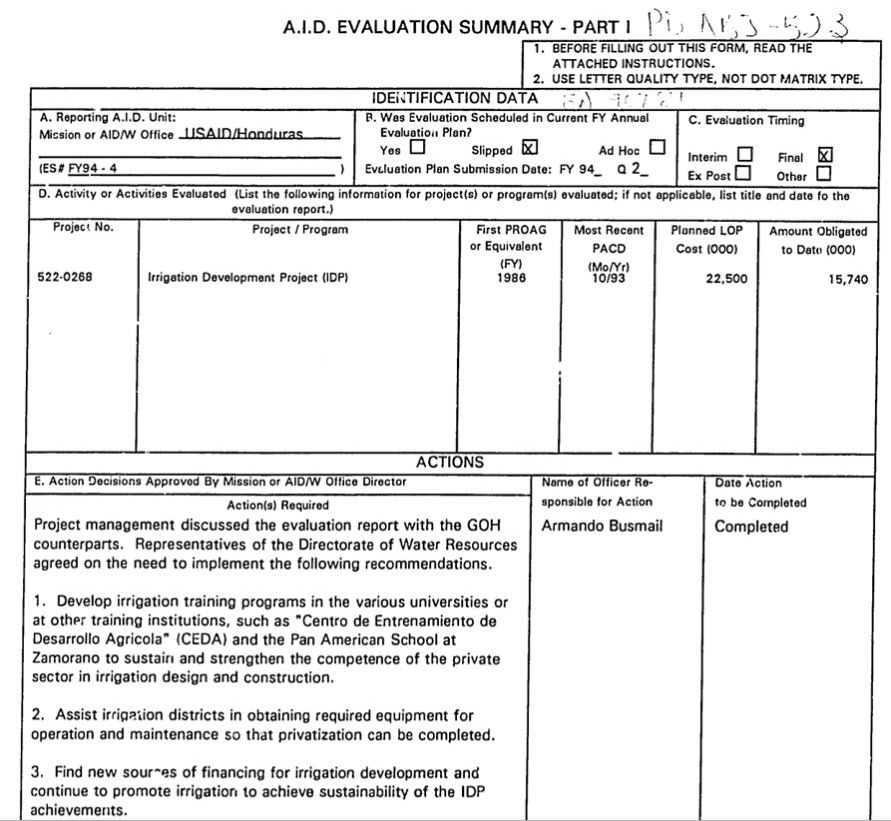 Honduras Irrigation Development Final Eval.1993.pdfHonduras Irrigation Development Project Interim Evaluation - 1989.pdf
The Logical Framework (Log Frame) process is a widely used methodology in project planning and strategy development within USAID and other international development organizations. It provides a structured approach to defining, implementing, and evaluating projects by linking objectives to activities and measurable outcomes. Below is an overview of the Log Frame process and its application to USAID projects:
1. Overview of the Log Frame Approach
The Log Frame is a matrix-based planning tool that clarifies the logical relationships between the inputs, activities, outputs, outcomes, and goals of a project. It ensures that each step in the project contributes to the overarching development objectives.
2. Components of the Log Frame Matrix
-
Goal: The broad, long-term objective the project contributes to. In USAID projects, this often aligns with strategic objectives in areas such as health, education, governance, or economic growth.
-
Purpose (Outcomes): The specific, measurable changes the project aims to achieve. These are the direct results of project activities and outputs.
-
Outputs: Tangible products or services delivered by the project (e.g., training sessions, infrastructure development, policy recommendations).
-
Activities: The specific actions taken to produce the outputs (e.g., conducting workshops, building facilities, developing materials).
-
Inputs: The resources (human, financial, material) required to implement the activities.
3. Key Features of the Log Frame
-
Indicators: Measurable signs of progress for each level (goal, purpose, outputs). These are specific and time-bound.
-
Means of Verification: Data sources or tools used to measure the indicators.
-
Assumptions/Risks: External factors that could affect project success but are outside the control of the project team.
-
4. Application in USAID Projects
-
Strategic Alignment: The Log Frame helps align individual projects with USAID’s broader country and regional strategies. For example, a project in agriculture might aim to align with goals of improving food security and economic stability.
-
Defining Objectives: By breaking down goals into measurable components, the Log Frame clarifies what success looks like and ensures that all activities contribute to these goals.
-
Monitoring and Evaluation (M&E): The indicators and means of verification are central to USAID’s emphasis on data-driven decision-making and accountability. The Log Frame serves as the foundation for developing M&E plans.
-
Risk Management: By identifying assumptions and risks, the Log Frame encourages proactive planning to address uncertainties.
-
Stakeholder Engagement: USAID often uses the Log Frame process to collaborate with local governments, NGOs, and other stakeholders, ensuring that projects address local needs and priorities.
-
5. Example Application
In a USAID-funded project on improving access to clean water, the Log Frame might look like this:
Goal: Improved public health in target communities. Decrease in waterborne diseases by 30%. Health surveys, clinic records. Local government supports health initiatives.
Purpose: Increased access to clean and sustainable water sources.90% of households use improved water.Community surveys. Infrastructure remains functional after installation.
Outputs: New wells and water systems were constructed.15 wells built by Year 2.Project reports, site inspections.Availability of skilled construction labor.
Activities: Conduct feasibility studies, train local operators, and build infrastructure.
Feasibility studies completed; workshops held.Reports, attendance logs.Community participation in training programs.
6. Benefits of the Log Frame in USAID
-
Clarity: Provides a clear blueprint of project objectives and pathways.
-
Accountability: Facilitates tracking and reporting on project progress.
-
Adaptability: Enables adjustments based on real-time data and evolving conditions.
-
Coordination: Aligns various stakeholders and resources toward common goals.
-
Using the Log Frame, USAID sought to ensure that projects are logically sound, results-oriented, and responsive to donor requirements and beneficiary communities’ needs.